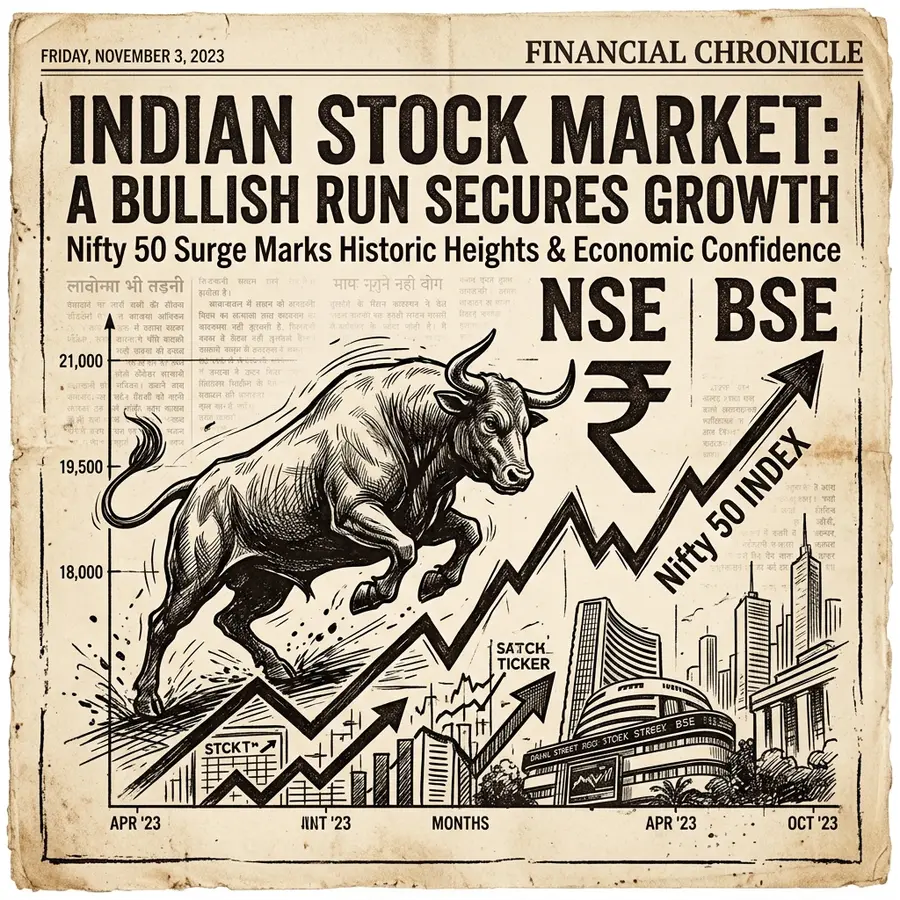
Every Indian finance news channel mentions Sensex first. Every WhatsApp market update leads with Sensex. But if you actually invest money in India, Sensex matters far less than you've been led to believe. Here's why — and what you should be tracking instead.
The Basic Difference
The Sensex (Sensitive Index) is the benchmark index of the Bombay Stock Exchange (BSE). It tracks 30 of the largest and most actively traded companies on BSE. First calculated in 1986, it's India's oldest equity index.
The Nifty 50 is the benchmark index of the National Stock Exchange (NSE). It tracks 50 of the largest companies on NSE by free-float market capitalisation. It's been operating since 1996.
Both are market-cap weighted. Both are rebalanced semi-annually. Both are owned and maintained by their respective exchanges — NSE Indices Limited for Nifty, and Asia Index Private Limited (a BSE-S&P Dow Jones venture) for Sensex.
Which Index Is More Representative?
Nifty 50 wins, clearly. Fifty companies cover more sectors and provide a more complete picture of India's economy than thirty. SEBI uses Nifty indices as the official benchmark for most mutual fund categories. The mutual fund industry uses Nifty-based benchmarks almost exclusively.
For an investor trying to understand how Indian markets performed on a given day, Nifty 50 gives a more accurate picture.
Why Does Media Report Sensex More?
Historical habit. Sensex has been around since 1986 — a full decade before Nifty. For ten years, it was the only widely reported Indian index. By the time Nifty launched, Sensex was already embedded in financial journalism language.
There's also a psychological factor: Sensex numbers sound more dramatic. A 1% fall in markets shows up as a 250-point fall in Nifty 50 but as a ~750-point fall in Sensex (because Sensex runs at ~3x the Nifty level). "Sensex crashes 1,000 points" sounds more alarming and gets more clicks than "Nifty falls 330 points" — even though they're the same market move.
Historical Performance: Nearly Identical
Over any long period — 10 years, 15 years, 20 years — Sensex and Nifty 50 returns are within 0.2–0.5% of each other. Their correlation is above 0.99. They move together because there's enormous overlap: the top 20 companies by market cap are in both indices. Differences in the 21st–50th stocks add some variation but nothing significant over long periods.
Which to Use for Your Investments
For investing, Nifty 50 is the standard. Nifty 50 index funds and ETFs have more AUM, tighter tracking error, and higher liquidity than Sensex equivalents. NIFTYBEES (Nippon India's Nifty 50 ETF) has the highest trading volume of any Indian ETF. Sensex ETFs exist but are significantly less liquid.
Track Nifty 50. Invest in Nifty 50 index funds. When you see Sensex news, divide by three to roughly translate to Nifty terms.
Frequently Asked Questions
Can I invest directly in the Sensex?
Not directly — you can't "buy the Sensex." You can invest in ETFs or index funds that track it. The BSE Sensex ETF exists but has low liquidity. Most investors are better off with a Nifty 50 index fund from UTI, HDFC or Nippon India.
Why does Sensex sometimes move differently from Nifty?
On any single day they can diverge slightly, because the 30 stocks in Sensex aren't always weighted identically to the same stocks in Nifty 50. If a stock with large Sensex weight (like Reliance or HDFC Bank) moves sharply, Sensex can diverge more than Nifty on that day. Over weeks or months, they converge.
Is there an ETF that tracks Sensex in India?
Yes — BSE ETF and Mirae Asset BSE Sensex ETF both exist. But trading volumes are low. If you want index exposure, stick to Nifty 50 ETFs which have far better liquidity and tighter bid-ask spreads.
Sensex vs Nifty 50: Full Comparison Table
| Parameter | Sensex | Nifty 50 |
|---|---|---|
| Exchange | BSE (Bombay Stock Exchange) | NSE (National Stock Exchange) |
| Launched / Base Date | 1986 (base date: 1978-79) | 1996 (base date: November 3, 1995) |
| Number of Companies | 30 companies | 50 companies |
| Calculation Method | Free-float market cap weighted | Free-float market cap weighted |
| Base Value | 100 (for 1978-79 fiscal) | 1,000 (for November 3, 1995) |
| Managed by | Asia Index Pvt. Ltd (BSE + S&P Dow Jones) | NSE Indices Limited (NSE + CRISIL) |
| Typical Level Range (2026) | ~75,000–80,000 | ~22,000–25,000 |
| Better for Investing? | Less liquid ETFs, fewer index fund options | Higher liquidity, more index funds, F&O base |
One quick note on the "typical level range": Sensex runs at roughly 3x the Nifty 50 level because of a different base structure. This is why "Sensex falls 1,000 points" sounds dramatic but is actually the same move as "Nifty falls ~330 points." Don't get misled by the absolute numbers.
Which Should You Track?
Short answer: Nifty 50 for actual investing decisions, Sensex for casual market news consumption.
Here's the more nuanced version. If you're an investor placing SIPs, choosing index funds, or tracking your portfolio against a benchmark, Nifty 50 is what you should care about. Almost every mutual fund in India uses Nifty-based benchmarks — the Nifty 50 for large-cap funds, Nifty Midcap 150 for midcap funds, Nifty 500 for multicap. SEBI mandates this benchmark comparison in all mutual fund disclosures.
Sensex matters if you're reading financial news from older publications or dealing with BSE-listed stocks. The BSE has some exclusive listings that aren't on NSE, particularly SME IPO stocks. For those, BSE's own indices are more relevant.
For the vast majority of retail investors in India — those running SIPs in large-cap or index funds, or investing in Nifty 50 ETFs — Sensex is largely noise. Useful as a broad market barometer, irrelevant for investment decisions. Track Nifty 50, invest in Nifty 50 index funds, and use Sensex headlines as context only.
Practical Takeaway
When a news anchor says "Sensex falls 1,200 points," divide by 3 to get the approximate Nifty equivalent (~400 points). Check what percentage that is of the current Nifty level — that's the actual market move. Everything else is just absolute-number theatre. A "1,000-point Sensex fall" sounds apocalyptic. A 1.3% market correction is the boring reality it usually represents.
Both indices will tell you the same story about Indian markets over any meaningful time horizon. The choice of which to follow is a matter of preference. The choice of which to invest in (via index funds or ETFs) should always be Nifty 50 — simply because the investment products tracking it are superior in liquidity, cost, and product variety.
For deeper reading: explore our complete Nifty 50 guide, understand how index funds work in India, and compare your options in our best investment options for India 2026 overview.